What is a digital workplace solution?
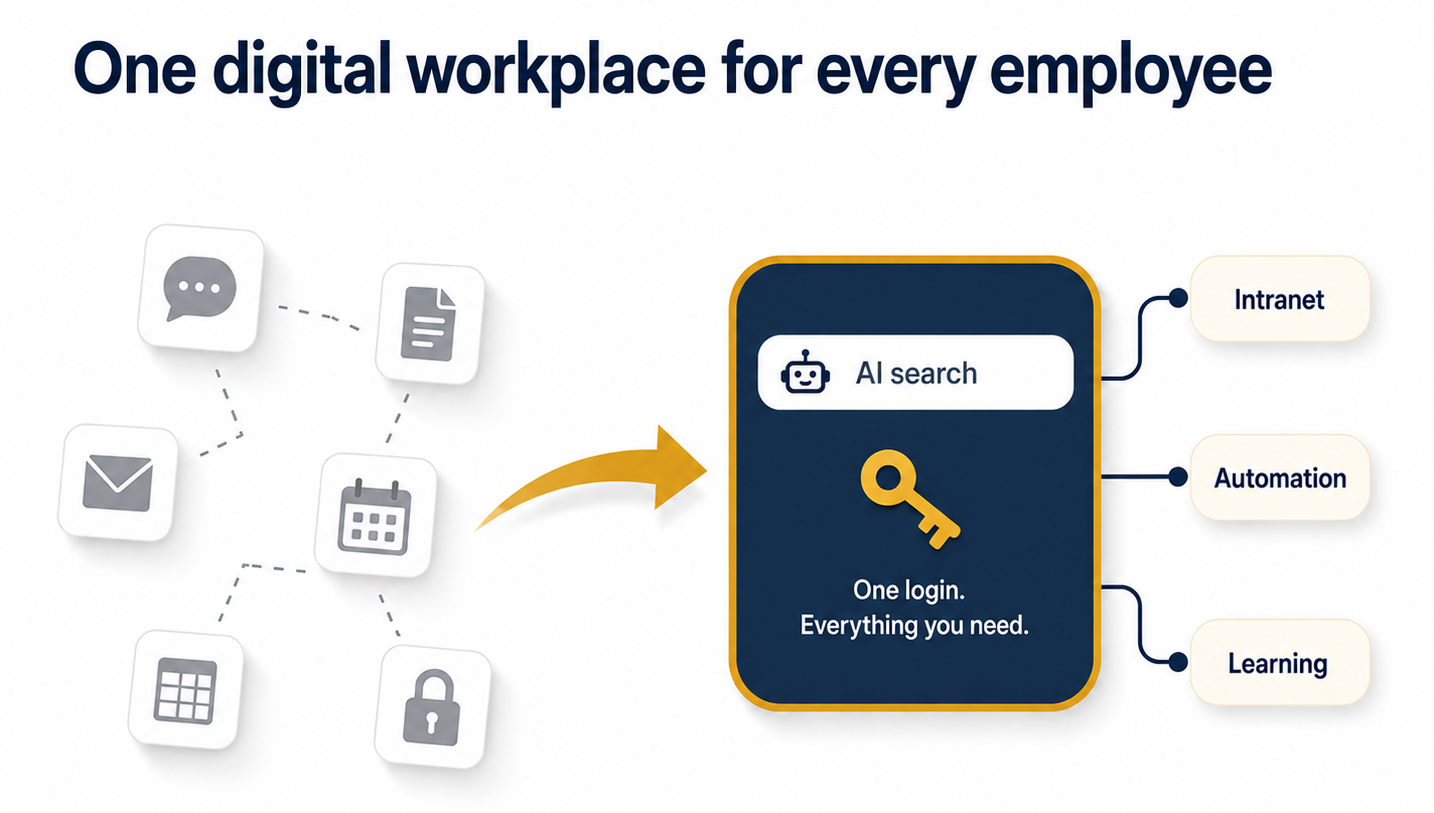
A digital workplace solution is a single online environment that connects your people, tools and content. One login, one search, every system in one place. It is not one piece of software. It is the layer that ties your intranet, your automated processes and your training together, so staff stop hopping between disconnected apps.
Think of it as the digital version of an office. The intranet is the front door and the noticeboard. Automation is the back office that moves requests along. Learning is the training room. A good platform puts all three behind one login, on the desktop and on a phone.
Why do UK businesses need one in 2026?
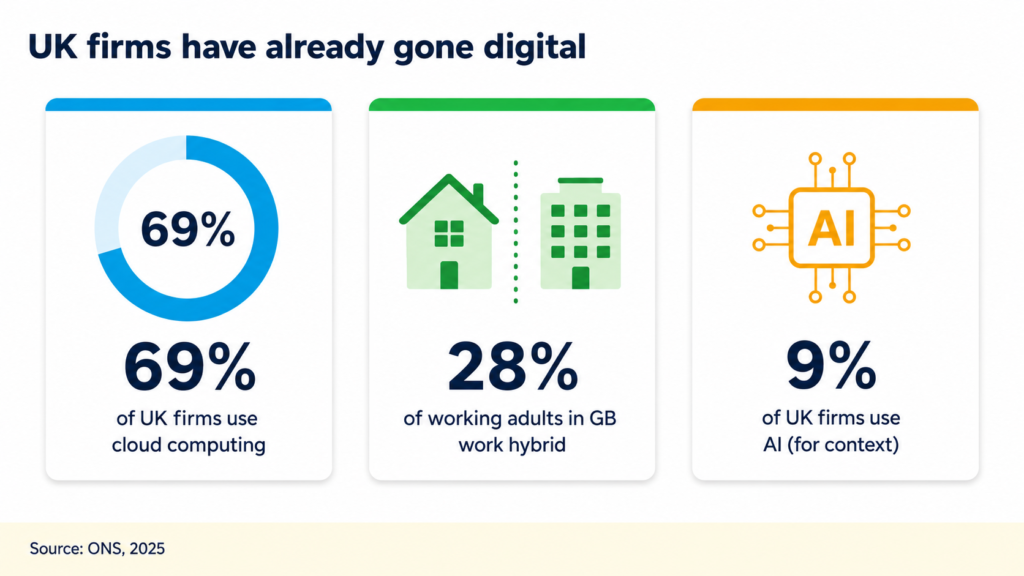
Because the way UK firms work has already changed, and the tools have to catch up. Cloud computing is now mainstream: 69% of UK firms had adopted it by 2023, far ahead of AI at 9% (ONS, Management practices and the adoption of technology and AI in UK firms, 2025). Work is split across places too. Some 28% of working adults in Great Britain were hybrid working in early 2025 (ONS, Who has access to hybrid work in Great Britain?, 2025).
Put those together and the old setup creaks. Staff log in from home, the office and the train, across half a dozen apps. One connected platform gives them one consistent way in, wherever they are. It’s no longer the upgrade. It’s the baseline.
What’s the real cost of disconnected tools?
More than most owners realise, because the cost hides in small switches. International research by Harvard Business Review found people toggle between apps and websites nearly 1,200 times a day, and lose just under four hours a week simply reorienting after each switch. Over a year, that adds up to about five working weeks (Harvard Business Review, 2022).
The pattern shows up in how the day gets spent. Asana’s own research puts “work about work”, the chasing, searching and status-updating, at 58% of the working day (Asana Anatomy of Work Global Index, 2023). That’s time your team spends managing tools instead of doing the job. Pull the tools into one connected platform and most of that friction goes away.
Scattered tools vs one connected platform
Here is the same working week, run two ways.
| The moment | Scattered tools | One connected platform |
|---|---|---|
| Logging in | A different login for chat, docs and HR | One login for everything |
| Finding a policy | Search each app and hope | One search across all content |
| A new starter | Set up by hand in six systems | One onboarding workflow |
| Proving compliance | Chase spreadsheets and emails | One audit trail |
| Paying for it | Many overlapping subscriptions | One annual licence |
The right-hand column is the whole point: fewer moving parts, less lost time, one place to look.
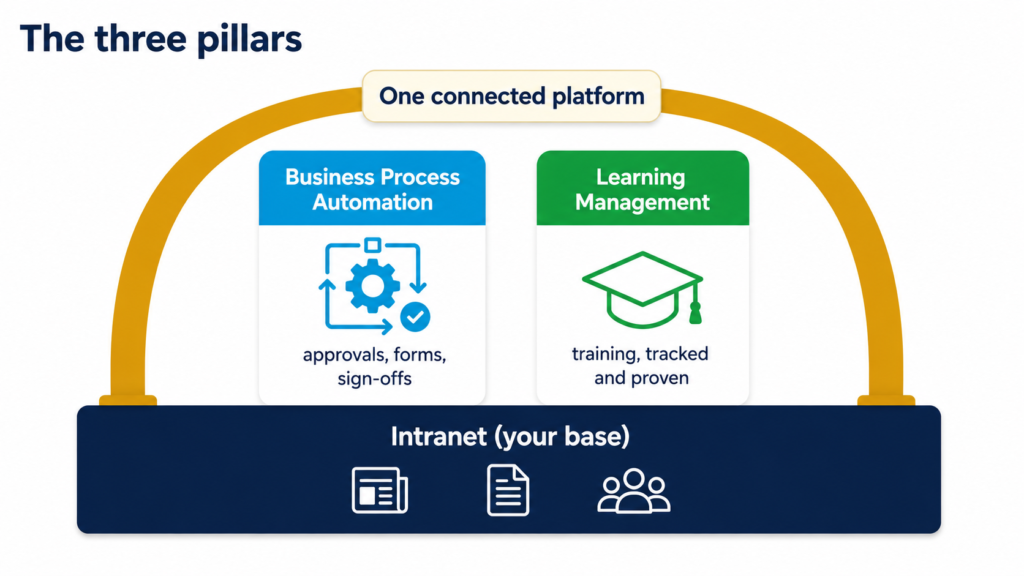
The three pillars: Intranet, Automation and Learning
Most digital workplace platforms stand on three pillars. You don’t have to switch all three on at once, but they’re designed to work together.
The Intranet (your base)
The intranet is the home base: news, documents, the staff directory and the single source of truth for policies. It’s always the foundation, with automation and learning sitting on top. If you’re weighing platforms, our comparison of the leading UK intranet platforms lays out the options, and you can see how a dedicated intranet compares with SharePoint if Microsoft 365 is your default. The latest Claromentis 11 release also added an AI search that answers staff questions from your own content.
Business process automation (the engine)
Automation handles the repeatable work: approvals, expense forms, onboarding checklists, compliance sign-offs. Each one becomes a tracked, auditable workflow instead of an email chain. If you’re deciding where to start, our guide to what UK SMEs should automate first is the practical next step, and the Claromentis process automation module is what runs it.
Learning management (the training room)
A learning management system hosts your training, tracks who has completed what, and proves it at audit time. It matters most where compliance training is mandatory. If you’re not sure you need one yet, our honest take on whether a UK SME needs an LMS walks through the test, and the Claromentis learning management system is the module itself.
Who is a Digital Workplace Solution for?
For UK SMEs that have outgrown a folder of apps, usually 30 to 500 staff. The upside is measurable: ONS found technology adopters were associated with 19% higher turnover per worker, that is revenue per worker, even after controlling for management practices and firm size (ONS, 2025). At a national level, Be the Business estimated that a sustained 1% annual lift in SME productivity would add 94 billion pounds to the UK economy over five years (Be the Business, 2023).
It earns its place fastest in a few situations:
- Hybrid or multi-site teams that need one source of truth.
- Regulated sectors like healthcare, finance or franchising, where compliance has to be provable.
- Growing firms where “everyone just knows where things are” has quietly stopped being true.
A very small, tidy team can manage on a handful of well-chosen apps. The case strengthens as headcount, sites and compliance load grow.
Is it secure and compliant enough for UK businesses?
Yes, when it’s set up properly, and security is a baseline rather than an afterthought. A serious platform gives you control over where data lives and who sees what.
- Hosting: keep data on your own servers or in a UK-based cloud.
- Single sign-on: one secure identity for everything, which is safer than many passwords.
- Permission levels: HR files stay in HR, finance stays in finance.
- Audit trails: see who opened a document and when, which makes GDPR and sector rules far easier to evidence.
One caution worth stating plainly. AI features only surface what a person can already reach, so fix permissions before switching them on. Pair any rollout with a clear AI usage policy so staff know what they can and cannot put into AI tools.
How do you choose and roll out a digital workplace solution?
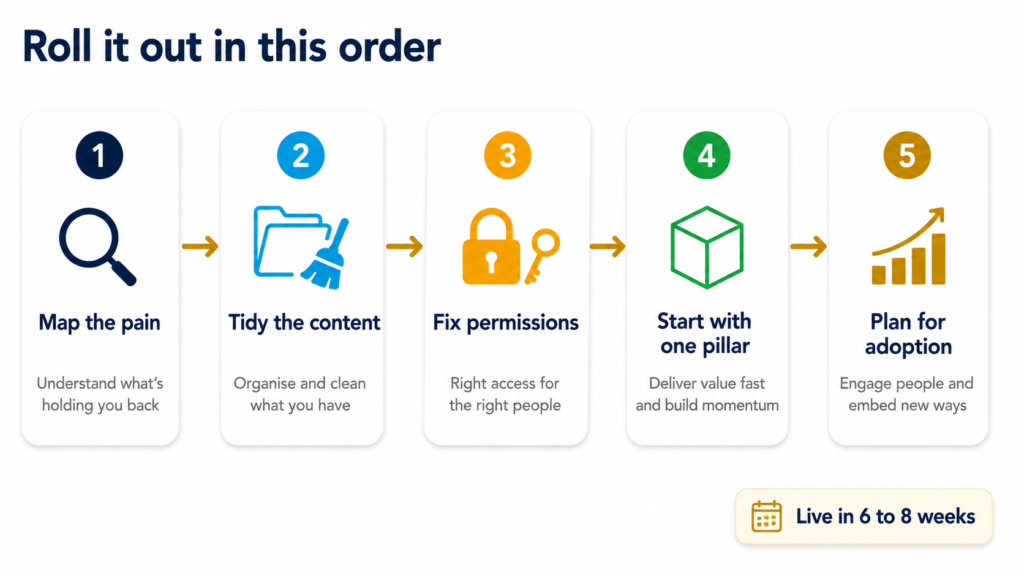
Start with the problem, not the product. Pick the pillar that hurts most, prove it, then add the others. Most UK SMEs are live in 6 to 8 weeks, not months.
- Map the pain. List where work stalls today: the chased approvals, the lost documents, the manual onboarding.
- Tidy the content first. Archive duplicates and name an owner for each key document. Search only works on content worth retrieving.
- Fix permissions. Decide who sees what before you connect anything.
- Start with one pillar. Usually the intranet base, then automation, then learning.
- Plan for adoption. Train lightly, launch, then measure use. Adoption beats features every time.
On cost, year one typically runs £8,000 to £25,000 for 30 to 100 users, with year two lower because the setup doesn’t repeat. Per-user rates depend on the modules you switch on, so a quick scoping call beats a list price.
The bottom line for UK businesses
A digital workplace solution isn’t a single app you buy. It’s the decision to run your business on one connected platform instead of a drawer full of disconnected tools. The evidence for going digital is strong, and the cost of fragmentation is real and measurable.
Start where it hurts most, get the content and permissions in order, then let the intranet, automation and learning sit together in one place. Do that, and the platform repays the effort. Skip it, and you’ve simply digitised the mess.